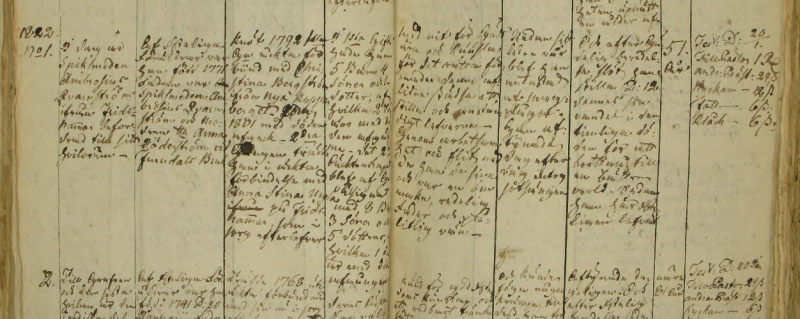
This list is a collection over time of words found in Swedish church books, as an aid in transcribing and translating those genealogical records. Examples of a word’s usage are given where helpful or interesting.
If there are two spellings in an entry, the first is usually the older.
Plurals and definite article forms are indicated in parentheses following the English.
The letters å, ä, and ö are distinct letters, and are filed in that order after z. Note that “aa” is a variant of “å”, and thus is filed after z.
If you don’t find a word in the list alphabetically, try the “search” tool on your keyboard, as an adjective etc. may be defined under the noun it modifies.
Please feel free to offer corrections, alternative translations, elaborations, etc. in the comments at the end of each section!
I have included links to my sources for the more-obscure or difficult definitions and/or to fuller definitions. Thanks also to members of the SWEDEN list at RootsWeb for their help!
— Jeanne Smith
Links to the other parts of the word list:
R-Ö
*******
ref = pain, difficulty
risen = rickets
rosen = erysipelas
rothjon = pauper
rus = drunkenness
rusthållare = cavalry-providing farmer (a title), one who provided the army with a cavalry soldier plus horse and equipment
rustmästare = an underofficer (non-commissioned officer) responsible for the care of the armory, weaponry, and ammunition within a company
ryckningar = convulsions
rättare = a foreman on a large farm
rödsot = dysentery
see also diarrhé, utsot
rötfeber = high fever with symptoms of bodily decay
see also fläckfeber
rötsår = rankling sore
sammastäd = same place
“der sammastädet”, of the same place
senare, sednare [?] = latter (den senare, the latter)
“Den förre bl. Enkl. i 1843 Febr. och den sedn. Ea. 1842 13/5”, the former was widowered in February 1843, and the latter widowed 13 May 1842
Septembris, 7bris = (Latin) September
septimanas = (Latin) weeks
“ætas 2 menses 3 septiman: 2 dies.”, aged 2 months, 3 weeks, 1 day
sjelf-mördare, sielfmördare, sjelfmördare = suicide (lit., “self-murder”)
sjuksvard = one who cares for the sick, nurse
“sjukvårdskorpral i flottan,” pharmacist’s mate in the navy
skarlakansfeber, scharlakansfeber = scarlet fever
skattebonde = farmer who owned his land and paid tax to the crown (similar to yeoman farmer)
skogvaktare = forester, gamekeeper
skrifta = shrive, confess
skriftlig och samtyckt = written and consented
skräddare = tailor
skörbjugg = scurvy
see also vattensot, andtäppa, gulsot
slag = stroke
sometimes any sudden death where the cause could not be determined, esp. in the case of an infant
slagne af åskan, slag af åska = killed by a lightning strike
slagt = kindred
“Ej slagt”, not related, not kindred (on a marriage record)
slut = end
slutet af Socknen, Socknens slut, Socknens tå, literally “the end of the parish”, an area were poor people were allowed to have cottages
smittkoppor = smallpox
smittosam sjuka = infectious disease
snickare = carpenter
spiksmed = nailsmith
spågumme = seer, clairvoyant, fortune-teller (female)
“spågubbe”, (male) fortune-teller
spögubbe = sexton; depending on context, this could mean either the sexton of a church, who sometimes during services carried a rod with which to prod sleeping church-goers, or a provost whose task was to carry out floggings. (Språkdata, University of Gothenburg: “Spögubbe a) kyrkvaktare, som hade till uppgift att i kyrkan med ett spö väcka sovande åhörare, b) profoss med uppgift att verkställa spöstraff”.)
stalldräng = groom, stableman
statdräng = labourer paid partly in money and partly in kind (lodging, grains, milk, etc.)
stenplåga, sten-passion = pain caused by stones
stickfluss = choking catarrh, accidental choking caused by a cardiac or pulmonary disease
stryplungsot, struplungsot = laryngeal tuberculosis
struptuberkulos
not the same as strypsjuka (diphtheria)
strypsiuka, strypsjuka = diphtheria
stryptvinsot = tuberculosis in larynx
styng = sharp pain in chest, sting
studios, studiosus = student, academic
stämma = constipation
ställmakare = one who manufactures the chassis or underbody of a wagon on which wheels and wagon body were attached; it can also have a more general meaning of wagon-maker
“ställningsmakare” [might be a variation or something different?]
susceptor = Latin, the godparent who held the child at christening (susceptor = masculine, susceptrix = feminine)
svaghet = frailty
“ålderdoms svaghet”, the frailty of old age
svagsint = feeble-minded, insane
svåger = brother-in-law
svägerska = sister-in-law
svällnad, svullnad = lit. “swelling”, abscess, tumor, edema
svärdotter = daughter-in-law
svärfader, svärfar = father-in-law
svärföräldrar = parents-in-law
svärson = son-in-law
sår-halssjuka = diphtheria
såsom, ss = as
sängeliggande, sängliggande = bedridden
“sängliggande i sistlidne”, bedridden at the last (i.e., at the end of his life)
särknamn = farm-name (särknamnet, the farm-name)
in much of rural Sweden, the farm-name was placed at the end of a person’s names (Anders i Backen, Kerstin Bengstdotter vid Dammen, etc.), but in Dalarna and surrounding areas, the farm-name was placed before the forename (Anniko Lars Andersson, etc.)
also gårdsnamn
tandplågor = toothache
tandsprickning = teething
see also hjärtsprång hos barn, tandsprickning, magref, maskar
tarmtvinsot = intestinal tuberculosis
tillstånds Bevis = certificate of permission
“och Compagnie Chefens tillstånds Bevis”, here probably a soldier who had his company commander’s written permission to marry
timmerman = carpenter
also snickare
tjenst, tjänst = service (employment as a servant/helper)
“Man nu i tjänst på”, [he is] now in service at …
torpare = crofter
torsk = thrush (candidiasis)
troligen = probably
trånsjuka = languishing
tvinsot = consumption (tuberculosis)
see also mjält-sjuka, trånsiuka
tyfus, typhus = typhus until the end of 19th century, after that typhoid fever
upplöst = dissolved
“upplöst hjonelag, upl. hjon”, a marriage dissolved [ended] by the death of one of the spouses
uppgiven fader = declared father (regarding an illegitimate birth)
upnått = met
uppsättare, oppsättare = one who fills up the blast furnace (masugn)
urinsot = diabetes
utfattig = penniless, destitute (not able to pay taxes)
utsot = diarrhea
valsverksarbetare = rolling-mill worker
vansinnighet = insanity
vatten i hjernan = water in the head (of children)
vatten-kräfta = necrosis in facial tissue (noma) caused by an inflammation on an unhealthy baby child
see also liksot
vattenstämma, vattustämma = urinary retention, anuria
vattusot, wattusot, vattensot, vattensvullnad = edema
see also andtäppa, gulsot, skjörbugg
venerisk sjukdom = veneral disease, usually syphilis
vita communis = Latin, way of living, usual lifestyle, character (lit. “common/everyday life”): a description of someone’s (usually a deceased person’s) character
“vita communis: gudfruktig stilla och sachtmodig”, vita communis: [he was] godly, quiet, and gentle
våda, vådeligen, döde af vådelige tillfällen, vådelig händelse = killed in an accident
“af våda skadat sig sielfva till döds”, mortally injured in an accident
“vådeligen dödade af andra”, killed in an accident by other people
“döde af egen eller andras våda”, killed in an accident caused by themselves or by other people
“döde af våda”, killed in an accident
vällsignat, välsignat = blessed
“är Vällsignat med 4 Barn”, was blessed with 4 children
värk = pain
wargerning, vargering = reserve
“wargerningskarl, vargeringskarl“, reserve soldier
värnplikts-förhållanden = conscription circumstances
as värnpliktiga förhållanden, in a column heading in some 1900s parish books
åderförkalkning = arteriosclerosis
allmän åderförkalkning, general arteriosclerosis
ålderdomskrämpor = ailments of old age
ålderdomssvag = infirmities of old age (ålderdomssvaghet, the infirmities of old age)
årbart = honorable, virtuous
ägtenskap, äktenskap = marriage
“träda i ägtenskap med”, enter into marriage with (träder, trädt)
“trädde han i ägtenskap med”, he took in marriage (with)
borgerligt äktenskap = civil marriage
Upplöst äktenskap = dissolved marriage. Note that this does not generally mean that the husband and wife were divorced, only that the marriage itself was no longer in existence, due to the death of one of the spouses
äkta säng, ägta säng, egta säng = of legitimate birth
ängelska siukan, engelska sjukan = rickets (lit., the English sickness)
see also risan
 A Bluestocking Knits
Leave a comment