This list is a collection over time of words found in Swedish church books, as an aid in transcribing and translating those genealogical records. Examples of a word’s usage are given where helpful or interesting.
If there are two spellings in an entry, the first is usually the older.
Plurals and definite article forms are indicated in parentheses following the English.
The letters å, ä, and ö are distinct letters, and are filed in that order after z. Note that “aa” is a variant of “å”, and thus is filed after z.
If you don’t find a word in the list alphabetically, try the “search” tool on your keyboard, as an adjective etc. may be defined under the noun it modifies.
Please feel free to offer corrections, alternative translations, elaborations, etc. in the comments at the end of each section!
I have included links to my sources for the more-obscure or difficult definitions and/or to fuller definitions. Thanks also to members of the SWEDEN list at RootsWeb for their help!
— Jeanne Smith
Links to the other parts of the word list:
H-Q
*****
Updated 21 December 2017
halss-fluss, halsfluss, halssvulst = tonsillitis
see also strypsjuka
halsröta = diphtheria
halssiuka, halssjuka = diphtheria
hammarsmed = blacksmith working at a large hammer
handelsidkare = tradesman
handtverkare = craftsmen (tailors, shoemakers, etc.)
hemmansbruk =
hemmansbrukare, tenant farmer [lit. “farm user”]
hemmanseg, hemmansägare, H. äg. = a person who owns a homestead or farm
hetsig feber, hetsig siukdom, hetsig sjukdom = high fever
hetsvulst = inflammated abscess
see also rosen, kallbrand
hjärnblödning = intracranial haemorrhage, stroke
hjärnfeber, hjernfeber, hjärnhinneinflammation = meningitis (meningitis cerebralis)
hjerninflammation, hjärninflammation = encephalitis (inflammation of the brain)
“hjärnhinneinflammation”, brain inflammation
hjärtförlamning = heart failure
hjärtlidande = heart problems (“suffering”)
hjärtsprång hos barn = fever and convulsions or epilepsy in an infant
see also tandsprickning, magref, maskar
hosta = cough
hufudsot, huvudsot = meningitis
hufvudwärck = headache
hujus, huius = Latin, of this (the same, e.g. month)
hunger = starvation
husman = cottager, crofter, tenant
hustru = wife
“Bägga Hustruarnas namn var Carin Jonsdotter”, both [of his] wives were named Carin Jonsdotter
håll och styng = stinging chest pain as in pneumonia
see also bröstfeber
hård mage = constipation
see also älta, magtorsk, trånsjuka hos barn
hängt sig = hanged himself
höftsjuka = usually a tuberculotic hip injury
Häradsskrifvaren = deputy clerk
inhyses = lodger
jordfästningen = burial
“jordfästningen författad av undertecknad”, the burial [was] authorized by the undersigned
kallbrand = gangrene
see also kräfveten, hetsvulst, rosen, kallbrand, bulnader, rötbölder, sår
kamrerare = treasurer (kamreraren, the treasurer)
kikhosta = whooping cough
klensmed = smith making small things
knippsmed = a smith producing knippjärn, iron or steel bars, used as raw material, e.g. for tool manufacturing
kolare = charcoal-burner (kolaren, the charcoal-burner)
kolos = carbon monoxide (kolmonoxidförgiftning, carbon monoxide poisoning)
könstnar = painter (artistic)
see also målare, painter (of houses, etc.)
koppor = smallpox
kramp = convulsion
kröger = publican (krögerska, female publican; krögerskan, the female publican)
kronobonde = tenant farmer on crown lands
krossade = crushed to death
“krossade af träd i skogen”, crushed by a tree in the forest
“krossade i grufwor”, crushed to death in the mines
krossning = to be crushed
see also benbrott, friska sår
kräfta = cancer
kräfveten = cancer
see also kallbrand
krämpor = ailments
kröger = publican (krögerska, female publican)
kvinperson see qvinperson
kyrkoherde = vicar
kyrktagning = “churching”, the ceremony blessing a woman after recovering from childbirth
Kyrkvaktmästare, kyrkovaktmästare, kyrkvaktare, kyrkväktare = sexton
landbonde = tenant farmer, leasing the land from someone else
lefwarna = conduct of life
lifsjuka, livsjuka = diarrhea
likmask = ulcerative stomatitis
see also barnkräfta
luckor = gaps
“med luckor”, with gaps (in the record, etc.)
lungemfysem, emfysem = emphysema
lungsot = tuberculosis, consumption
lägerplats = burial place
lägerställe = military campsite, or place where a person could lay down to sleep
“Och Herrens molnsky svävade över dem om dagen, när de bröto upp från sitt lägerställe” = “Then a cloud covered the tent of the congregation, and the glory of the Lord filled the tabernacle” (Exodus 40:34).
länsman = sheriff
lärare = teacher
lärling = apprentice (lärlingen = the apprentice)
lönskaläge = extramarital sexual relations, in this case between unmarried persons; this usually could be proven only by pregnancy. The penalty was a fine, usually ten riksdaler for the man and five for the woman.
lösa = loose, can also be used in regard to a person without employment contract
magflen = gastritis
see also andtäppa, gulsot, bukref, colik, förstoppning
mage-ref, magsjuka = stomach disease
magsvårighet = stomach trouble
magtorsk =
see also hård mage, trånsjuka hos barn
maka = spouse
”och dess k. Maka”
marasmus senilis (Mar. senil.) = progressive atrophy of the tissues due to old age (not necessarily senility of the mind)
maskar = worms
see also hjärtsprång hos barn, tandsprickning, magref
medfödd svaghet = congenital weakness.
mjält-sjuka = disease of spleen, usually pains in the upper abdominal region and left rib.
also “hypochondria” mental illness (that is, with men; the same symptoms with women were considered as “hysteria”)
mjölkkastning = lit. “milk-casting, -throwing”, a sickly state affecting some post-partum women; it was thought that sometimes when lactation ceased (for whatever reason) the milk was “cast” instead onto the woman’s internal organs, causing sickliness and sometimes death.
mjölnare = miller
moder = a union of two (or more) parishes has a moder (mother) parish, and one or more annex or “inferior” parishes
morgongåva = a gift often given by the groom to the bride the morning after the wedding.
myndig, myndige = of age
mässling, messling = measles
mästersven = master’s apprentice
målare = painter (of houses, etc.)
see also könstnar, artistic painter
mördade = murdered
nerffeber, nervfeber = typhoid fever
niur- och blåsesten = kidney and bladder stone
njurinflammation = pyelonephritis (renal inflammation/infection)
non bona nota = (Latin)
Novembris, 9bris = (Latin) November
nykter = sober, non-drinker
nämndeman, nemdeman = juryman, lay judge
närvarande = present, not absent
nöddöp = emergency baptism, often performed at home if the child was not expected to live, or sometimes if the weather prevented taking the child to church; an official “confirmation” (bekräftas) of the baptism was expected to follow
oangifven sjukdom = unstated illness
obefintlig = absent, whereabouts unknown
obekant = (cause of death) unknown
obestämd, obest. = unknown, undetermined
“Obest. ort”, [in an] unknown place
Octobris, 8bris = (Latin) October
oklanderlig = impeccable
oklandradt, oklandrad = faithful
olyckshändelse = accident
oppsättare, uppsättare = possibly a worker setting up a furnace or blast oven for use
organiskt hjertfel, hjärtfel = organic heart disease (an overall term that refers to any type of heart disease where the heart itself is affected, and doesn’t function as it should, due to a physiological problem, such as a deformity or inflammation)
orkeslös = decrepit, infirm
Pasato =
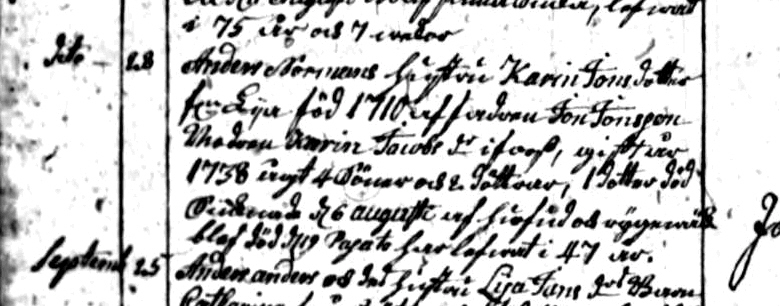
Näsby (T) OIa:1 (1614-1862) Image 250 / page 407 (AID: v63908.b250.s407, NAD: SE/ULA/11161)
“blef död d. 19 Pasato“, perhaps “passed”? as in “the 19th just passed”?
penningar = money
“utlagt penningar”
piltebarn = boy-child
see also flickabarn, girl-child
plåtsmed = tinsmith
precis, precist = exactly
“24 år précis”, 24 years exactly [usually meaning “to the day”]
puddlare = one who handles the furnace for puddling, a method for converting pig iron into wrought iron (puddlaren, the man who, etc.)
“puddelugn”, the furnace itself
“puddeljärn”, the iron/material
qvinsperson, quinsperson, kvinsperson = a woman who had given birth to an illegitimate child (usually, though not always, used in reference to a woman who had more than one illegitimate child)
“qvinsp. Lisa Mattsdr.”
“Qv. P. Inh. Maria Greta Hammarström”
Note that this usage was not official or universal, and that in some parishes a woman with only one illegitimate child could still be called “piga”.
qväfde af mödrar, kväft af modret = suffocated to death under (the) mother; though accidental suffocation certainly could and still does happen, sadly the death of an infant was often blamed on the mother in this way when there was no other visible explanation (e.g. genetic disorder, heart problems, hidden infection, SIDS, all more easily diagnosed today)
“qväfde af ammor”, suffocated under the (wet-)nurse
“förqväfd af modern”
qväfning, kväfning = suffocation
 A Bluestocking Knits
Leave a comment