This is another mish-mash post, all of the little bits and bobs that separately don't make up much of a post!
I finished knitting the Hug-Me-Tight a month and a half or so ago, and sewed it all together — unfortunately the result is a resounding "meh". Am not really sure if I simply made it too big (this is the larger size) or if the drape of the Cashsoft is too lazy to show it off much, or if blocking would help — but it resides on the top of the end table still.
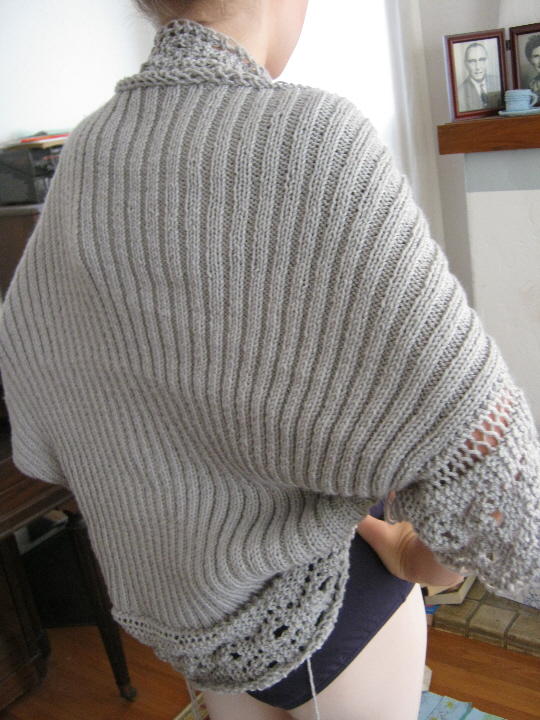
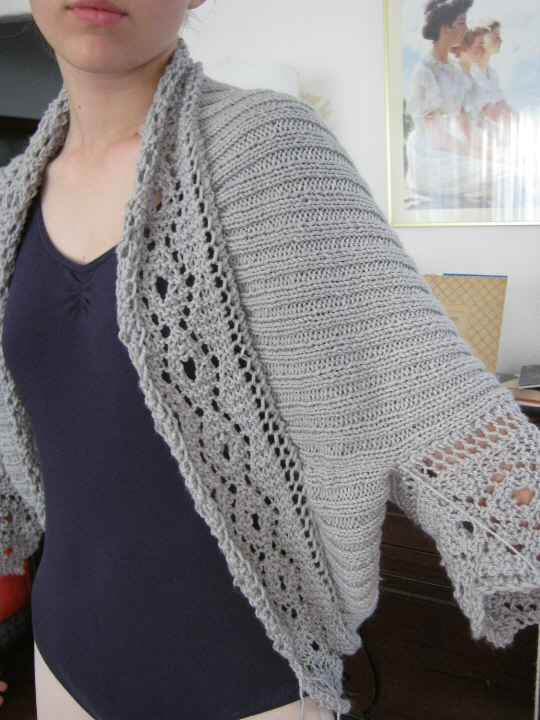
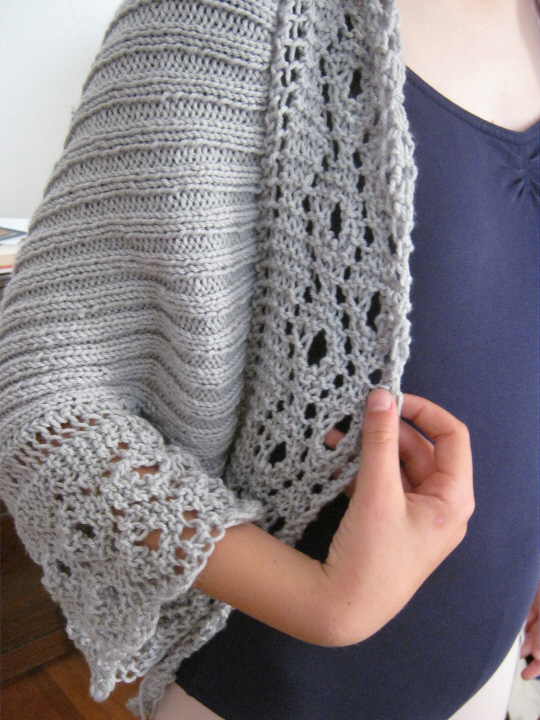
It looks even worse on me than it does on Laura. Not sure yet whether or not I'm going to rip it out or block it and hope for the best — I'm inclining towards the former, as I suspect that the Cashsoft won't block much. The larger border is curling I think because it is basically a circle, so that the outer edge is simply stretched too far. It may just be a matter of the wrong yarn for the project. Sigh.
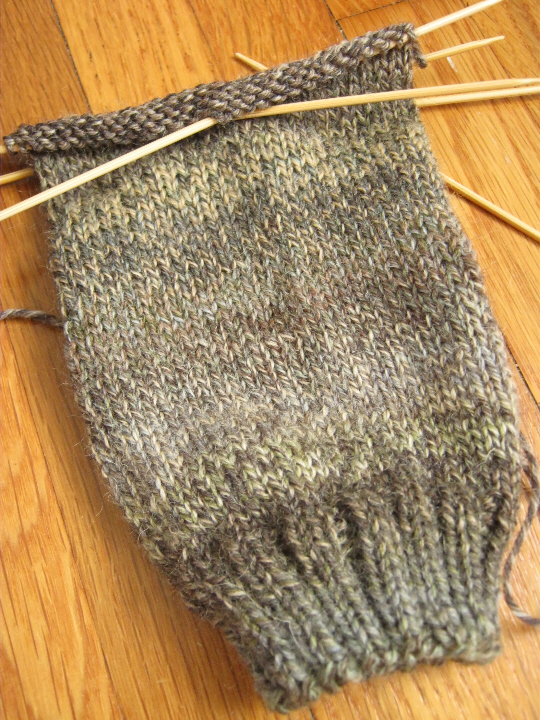
Also on the needles are an Elizabethan-of-sorts stocking, and a generic sock in Paton's Kroy "Camo Colors" — huge gauge, it seems! so it's working up gratifyingly quickly as I pass the time during various dentist appointments and piano lessons.
Last week I went to Michael's for a piece of embroidery fabric, and started a blackwork sampler. I was so amazed that my local public library actually had two books on blackwork (three, really, although apparently one is missing, as my request for it is still hanging in the ether somewhere), that, really, I could hardly not.
I first worked a simple all-over pattern from Rosemary Drysdale's The Art of Blackwork Embroidery (Scribner, 1975), and then jumped in to the two patterns from Jane Pemberton's smock, charted here by Kirrily Robert, aka "Lady Katherine Rowberd" of the SCA. Here is the original Holbein miniature again — this picture isn't as detailed as the one I posted before, but I love the little pearls (or water sapphires?) on the frame, which isn't included in most of the images of the miniature:
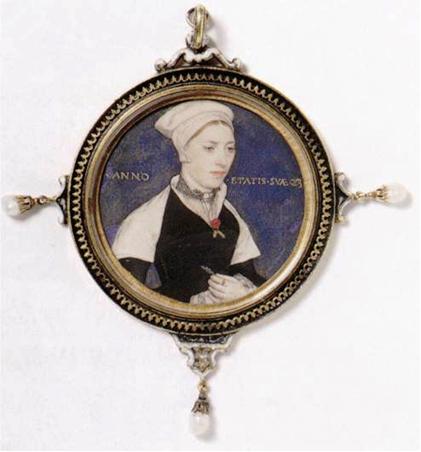
Wikipedia reports that her name was Jane Pemberton, later Jane Small, daughter of a Northamptonshire gentleman and later wife of a London cloth merchant, and dates the miniature to around 1540.
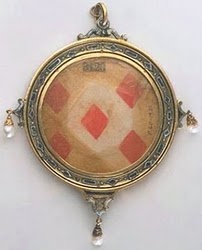
And just because I get such a kick out of it, here is the back of the miniature:
These two blackwork patterns are worked mostly in Holbein (or "double running") stitch.
I made a slight modification to the collar pattern as given by Rowberd in that I eliminated the little bar across the end of the Celtic-like ribbonwork between the diamonds — I thought this made the ribbonwork a little more obvious. It made the set-up more difficult, in that I couldn't simply work the main diagonals straight across but had to count out where to leave off those stitches. This picture is how the diagonals look before working the fiddly bits:
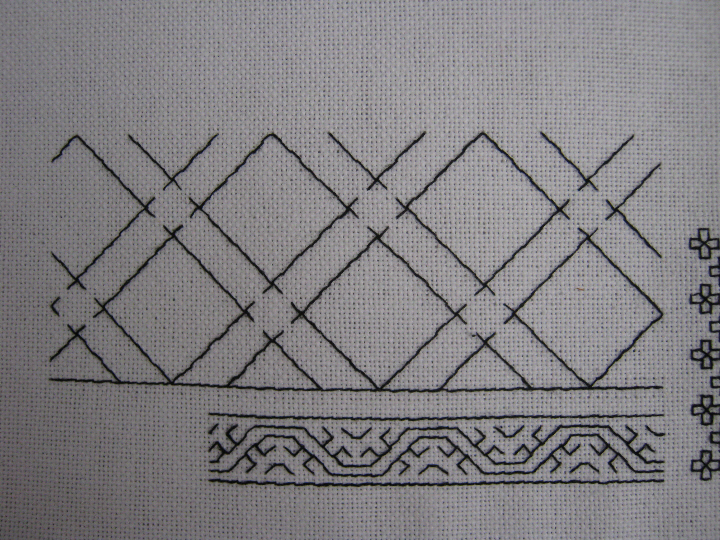
I still haven't figured out the "right" way to do blackwork — if there is only one — I found another photo of this pattern in progress by someone who worked each section separately. There is much to be said for that method, as it isn't nearly so nerve-wracking wondering if you've left enough room or counted correctly. (In fact, you can see in the above photo where I assumed that the diagonal I was working would "bounce"off of the top margin, and I had to pick it out.) If you get the set-up right, though, it is usually progressively easier to work each element, because you can see where each one sits, as well as how it fits in with the previous elements.
This, by the way, is worked on 28-count Monaco cotton with one strand of black floss, over two threads per square of the chart. Ragnvaeig's scarlet piece is obviously worked with at least two strands, and is therefore much denser, but I think that color on white linen is just gorgeous.
Here is mine with some of the ribbonwork completed and one on the third of its four passes:
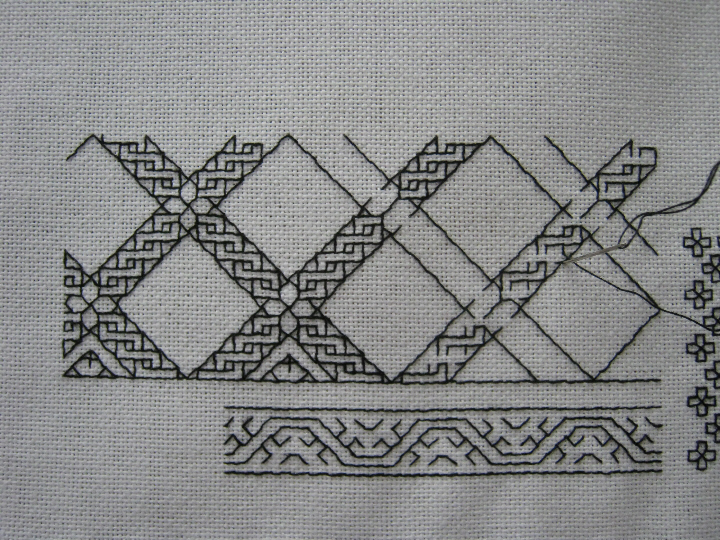
I'm not sure yet if the wobbliness of the lines is due to my amateurishness, or just the nature of the thing, that sometimes the thread gets crowded in the hole of the fabric and sits differently. Luckily, from a distance, you can hardly tell….
And here are the finished collar and cuff patterns:
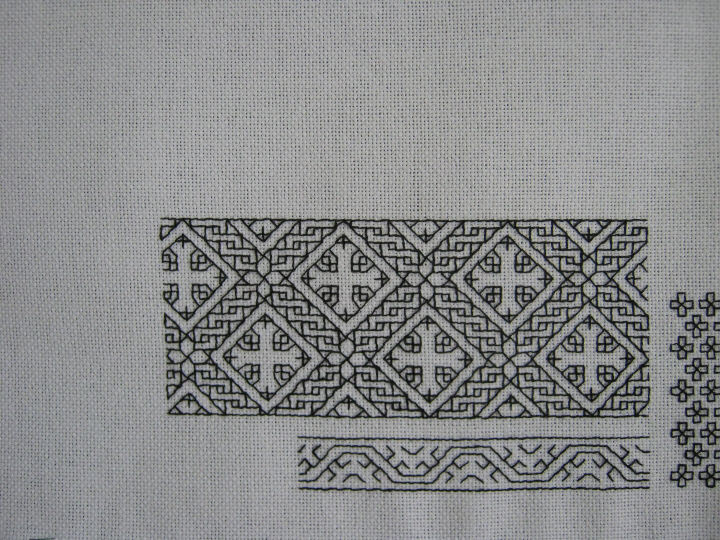
I actually don't like the cuff pattern much (it looks a bit choppy, I guess), and upon reflection would probably work a line of the ribbonwork on its own for the cuff. Rowberd details her re-creation of Mistress Pemberton's smock here — alas, though, without a photo of the finished garment.
And for those who are tired of blackwork, a paper crane that Julia folded one afternoon, to my astonishment and delight —


 A Bluestocking Knits
Leave a comment