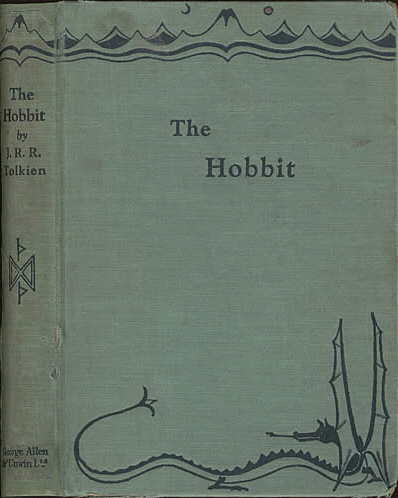
The girls and I finished reading The Hobbit last night. Reading it aloud was quite a different experience from reading it silently. Certainly I found myself aware of the pronunciation of names, and how often I'd gotten them wrong, and still do. I read so much as a child that I often pronounced words the way they looked; I still do this with "sword", for instance, including the "w". It's hard, reading The Hobbit now, not to say "biffer, bohffer, and bom-ber" especially, partly because the habit is so ingrained after all these years, and partly just because it's funny. This led to my thinking last night that I would write notes (in pencil, of course) at the bottom of a page where the name appeared, and so this morning I made a list, then started here at Tolkien Geek, and travelled to far corners of the Tolkien internet universe, especially to Wikipedia and The Encyclopedia of Arda. I did not actually find one single list of pronunciations, and so I post it here, willing and ready to accept discussion were someone with greater knowledge to comment.
I puzzled over "Dáin son of Náin" quite some time. "Dane son of Nane"? "Dine son of Nine?" Alas, there is yet no consensus. I found "An Analysis of Dwarvish" delightful in its very thoroughness, although, surprisingly, given that thoroughness, nowhere are the acute-o as in Thrór and acute-a as in Dáin mentioned. Possibly this is because Dáin, Glóin, etc. are use-names in Westron and thus translations from the Dwarvish ….
Also rather surprisingly, no one seems to divide these names into syllables. I have seen the occasional phonetic spelling that differed from the usual, and included them below. (A deeper study of the root words would be useful here, but, well, I haven't got the time.)
"Bilbo" should, I suppose, strictly be pronounced "BEEL-boh". I have never yet heard anyone say it like this.
The "r" should be a lovely rolling sound, which most Americans don't or can't do — listen to a Swede saying them at Tolkien Pronunciation Recordings, or even better, to Tolkien himself reading some excerpts from The Lord of the Rings. I've written this below as double-r.
Balin = BAH-leen
Beorn = BEH-orrn or even BAY-orrn, not BEE-orrn; compare Beowulf
Bifur = BEE-foor.
Bofur = BOH-foorr
Bombur = BOHM-boorr, with the “o” long as in “go” not short as in “bomb”, or possibly BOH-mbur
Carc = KARK
Dáin = DAYN; probably not “dine” as in “nine” and “line” as that would be the Elvish pronunciation
Dori = DOH-rree
Durin = DOORR-een, with the “u” long as in “boot”
Dwalin = DWAH-leen
Fíli = FEE-lee
Gandalf = GAHN-dahlf, with a short “a” sound as in “father”; or possibly GAH-ndalf; not "GAHN-dalv"or "GAN-dalf/v"
Girion = GEE-rree-ohn, with a hard “g” as in “go” and “get”
Glóin = GLOH-een
Golfimbul = GOHL-feem-bool
Gwaihir = GWY-heerr, with a hard “g”, and a long “i” in the first syllable as in “eye”
Kíli = KEE-lee
Nori = NOH-rree
Náin = NAYN; see above under Dáin
Ori = OH-rree
Roäc = RROH-ahk
Smaug = SMOWG. There is quite a lot of discussion about as to whether this is pronounced "smowg" or "smog". I started out with the American "smog", pleased by the association of dragons with nasty, smelly air pollution, then later evolved to a more RP "aw" sound. Technically, the vowel should be "ow", as in "town" and "clown", and in the interjection you use when you bump your head, which, not coincidentally, is the same as the equivalent modern Norwegian interjection, "au".
Thorin = THORR-een
Thranduil = THRRAN-doo-eel
Thráin = THRRAYN; see above under Dáin
Thrór = probably THRRORR; it is unclear why the vowel has a diacritic, or how this affects pronunciation
Óin = OH-een; it is unclear whether the letter “ó” is merely an “o” with a diacritic, or if it is a separate letter and therefore should take a separate place in the alphabet as does the Norwegian “ø”


 A Bluestocking Knits
Leave a comment