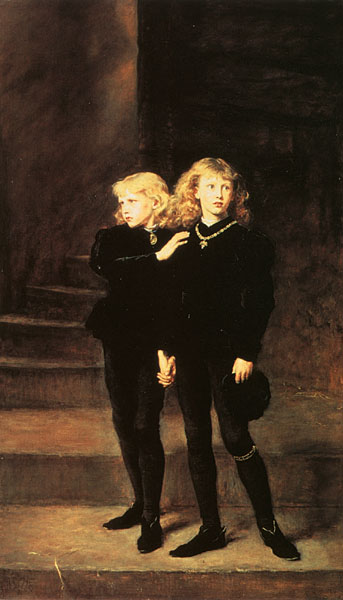
John Everett Millais, "The Princes in the Tower" (1878), Royal Holloway Picture Gallery, University of London. When I was small, I had a set of books, about a dozen in all, bound in red and containing according to the volume, all types of stories from fairy tales to "modern" stories to historical tidbits. My favorite was the third volume, the fairy tales, and I read that one over and over again — I can still picture the look of the books, and it is now one of my greatest bookish regrets that I didn’t keep them (I don’t know what I was thinking). Anyway, one of the volumes had a color plate of this painting and a rather melodramatic version of the story. I remember being fascinated by it — an early factor, I guess, in not only my burgeoning Anglophilia, but in my later interest in murder mysteries!

Gianlorenzo Bernini, "Francesco d’Este, Duke of Modena" (1650-51), Galleria Estense, Modena. A bravura piece by a master sculptor. I am constantly amazed at the apparent ease with which he made marble look like silk, lace, ringlets, leaves, lace, like flesh and blood.

James McNeill Whistler, "Nocturne in Black and Gold (The Falling Rocket)" (1875), Detroit Institute of Arts. It’s hard to imagine the stir that this painting created in the 1870s — the critic John Ruskin said that it was like flinging a pot of paint in the public’s face. (Whistler promptly sued him for libel and won, but it wasn’t much of a victory, as he was awarded a mere farthing in damages.) It’s certainly not a "realistic" painting in the usual sense of the word, but if you’ve ever seen the remnants of fireworks falling from the sky, you’ll have to agree that this is very much like it, the smoke grey against the black, the bits of colored fire falling like snow. I think it’s wonderful.

Anna Ancher, "Ung Pike som Ordner Blomster (Young Girl Arranging Flowers)" (1885), Aarhus Kunstmuseum, Copenhagen.


 A Bluestocking Knits

Leave a comment