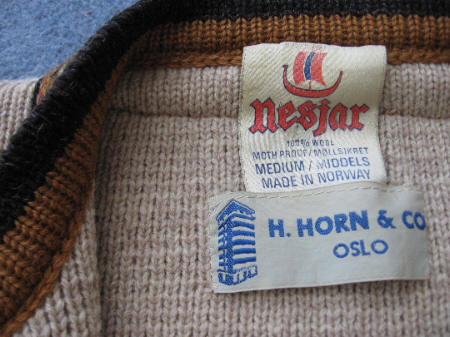
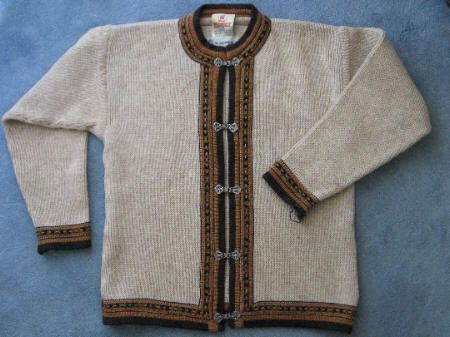
My father-in-law is a wonderful person, and I don’t mind the whole world knowing that I think so. When my mother-in-law asked me if I could mend his favorite cardigan as a surprise birthday present, I jumped at the chance. He bought this sweater some thirty-five years ago on a trip to his ancestral home in Scandinavia. Unfortunately for the sweater, he loved and wore it so much that the cuffs gave out, causing it to be packed away in the closet for years.
I also found a number of moth holes, so this turned out to be quite instructive for me, as well. I’ve always shuddered when faced with the possibility of something needing mending, but I will say now, it isn’t as bad as you might think.
I took the sweater to my favorite yarn shop, and asked one of the owners for some advice on wools. "Oh, well," he said dubiously, shaking his head, "you’ll just have to look through the store, until you find something that matches," and he handed me a skein of black Sandesgarn Smart superwash, and left me to it. I looked through the whole place after that, but it turned out that the Smart was indeed the best choice. The sandy-brown of the body has a hint of slightly darker sand in it, but the rich coffee-brown wool at the edges has an almost silvery hair running through the brown that gives it a lovely depth, and the skein of Smart has this same hint in it.
The shop owner also suggested tapestry wool, which as soon as he did stirred something in my memory to the same effect. There is not only a very wide variety of colors available, but you also don’t have to buy very much at a time, either. I ended up getting a pretty close match for the main color with a dollar’s worth of tapestry wool,
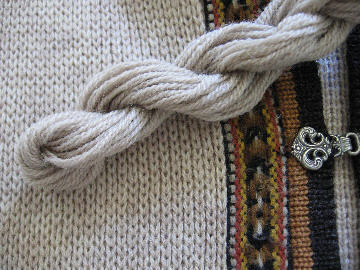
and took the black Smart for the cuffs. I didn’t notice until afterwards that there was also a small hole in the burnt orange inside the neck hem, so I had to go back for another bit of tapestry wool — "oh, no," I said aloud, to no one in particular, "I have to go back to the yarn shop."
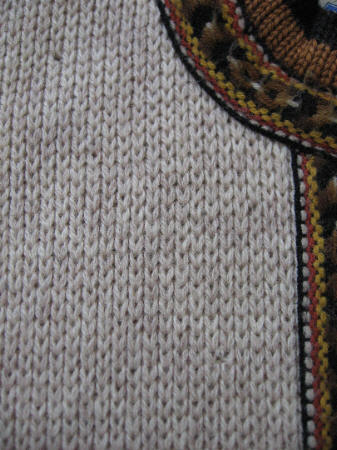
Many moth holes are, of course, obvious, but I found a number of not-quite-holes by holding up the sweater to the sunlight, which showed them quite clearly. I didn’t see the third one here until I did this —

There is surprisingly little in knitting reference books about mending. Luckily for this particular repair, which usually involved only one stitch per hole, duplicate stitch (also called Swiss darning) is an excellent solution. Most reference books have full diagrams and instructions on this for stockinette, and Theresa Stenersen’s article is very helpful as well.
The brioche stitch of this cardigan involves a more complicated maneuver with the needle than plain stockinette, and for the first five or six holes, I had to turn the piece for each stitch, working first the front loop, then the back loop separately. (I dreaded the sleeves, which this way would have meant doing the front loop, turning the sleeve inside-out, doing the back loop, turning the sleeve right-side-out, doing the front loop….) But after a while, something clicked in my mind, and the maneuver became much less complicated. Stick with it — it gets easier with practice. Don’t be tempted to skimp on the anchoring stitches on either side of the hole, as an inch to an inch-and-a-half of anchoring stitches will not only keep the loose ends from ravelling, but it will also give you a bit of practice, a running start if you will.
Since I am right-handed, I found it easier to work from right to left at first. Bring the needle up through the bottom of the first stitch (the V-shape), and around the first loop at the top,

then down back through the bottom of the first stitch and without going all of the way through the fabric aim the tip of the needle out toward the left. Push the fabric out a little from the back, if you can, so that it is easier to see the direction of the original wool. It’s a bit like following someone through a tight maze; just stick close. The brioche doesn’t go straight across to the next V from here as the stockinette would, but up again and slightly to the right, almost underneath the first stitch, then across in a purl bump,
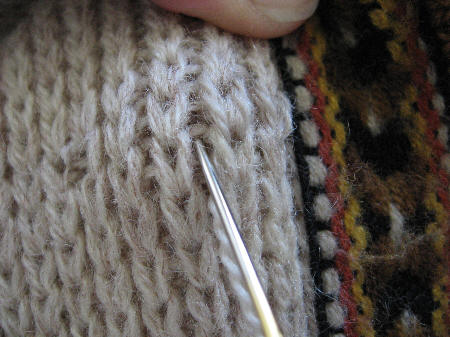
then down again slightly to the left, and under the lower purl bump, to come out at the bottom of the next V.
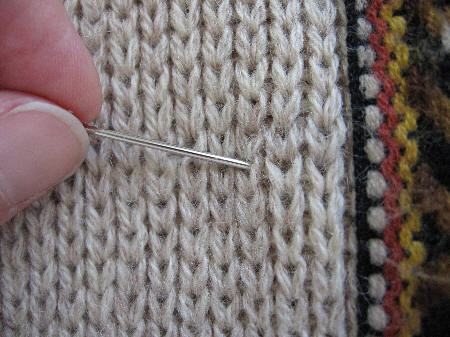
Or, work the first knit stitch from the front — up from the bottom of the V, around at the top, and down again at the bottom of the same V, and do go straight through to the back. Turn the work over, and work another knit stitch where the wool is placed — this V will be smaller than the front V —
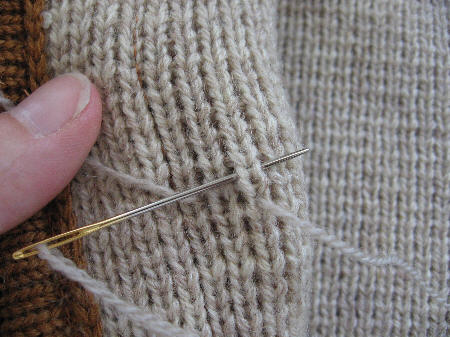
and straight back through at the point of that V, to the front. I’m fairly sure that this doesn’t quite capture the form of the brioche, but it is nearly invisible, and that is, after all, what counts in mending.
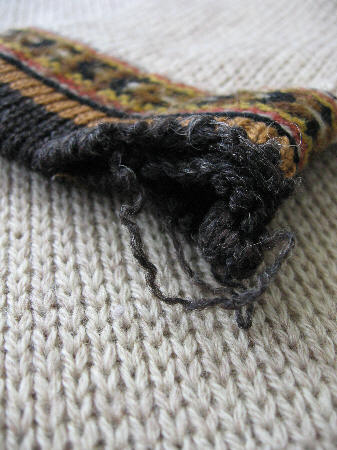
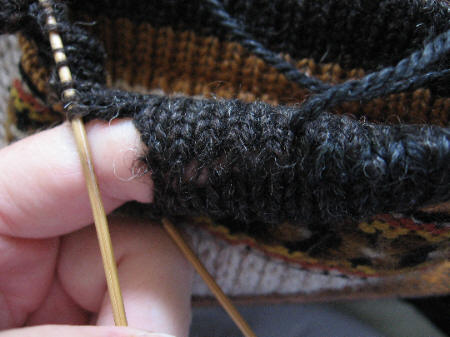
One of the cuffs was frayed completely, which involved picking up the loose stitches — which thanks to the lovely hairy wool had dropped only one row — replacing the dropped row, and grafting the two sides back together. (The lump in the middle is the seam of the sleeve, which was worked flat and sewn together. Being at the underside of the wrist, it was the first thing to go.) The Smart is a 4-ply, and so I pulled out one of the plies to make it a more similar weight to the original wool, but I didn’t want to do more than that and compromise the strength of the wool.
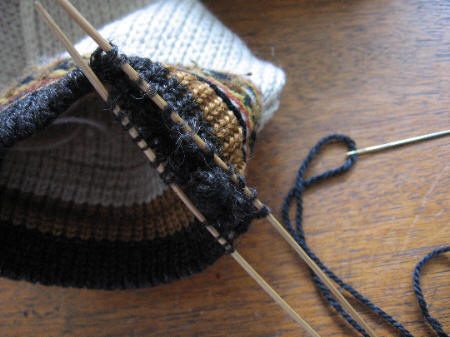
In a way, it was nice that there was actually an open section, as I could put my finger inside the hem and see clearly where to put the darning needle.
I stopped for a moment, literally to smell the roses, as the "Gertrude Jekyll" bush just outside the sunroom window is covered with gorgeous blooms, and so I brought some inside to enjoy close-up. Thorny things, but a heavenly scent, not to mention the color.
The section of cuff that was the most frayed looked a bit wonky when I was finished, but on the whole it went back together pretty well, I thought. The whole fold line was looking a bit thin, so I darned that row all of the way around.
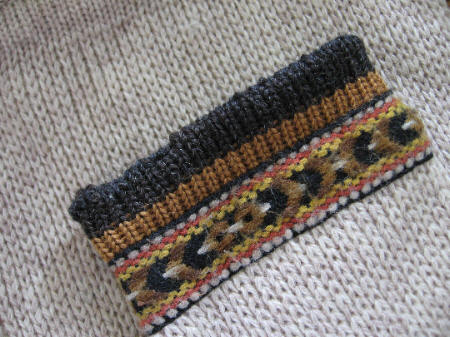
The other cuff was just held together —
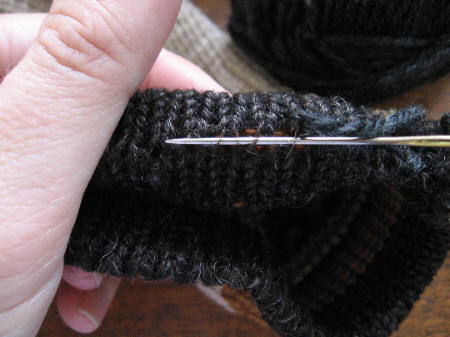
but with a good strong light and a large, flat surface to work on, the duplicate stitch went very smoothly. The black is rather obvious against the coffee-brown original, but this is less apparent when folded in its usual position. I still like the depth that the little silvery fibers give the wool, both the original and the Smart, and I think that a flat brown mend would have actually stood out a bit more against the original.
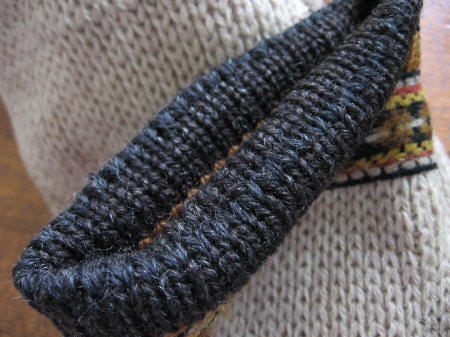

The hole on the inside of the collar was a cakewalk after the brioche and the cuffs,
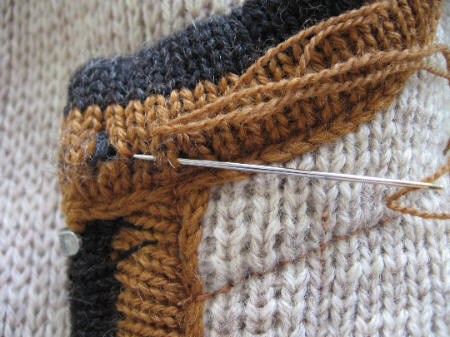
duplicate stitch up to and around the hole, pulling the ends inside the turned-over hem.
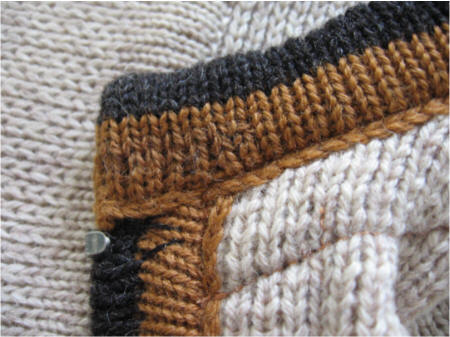
Tapestry wool does have a different texture than this wool, but after washing and a few judicious tugs, this will settle in. I don’t usually iron knitted things, but early on I decided that this one actually requires a good pressing, since the uniformity and flatness of the machine-knitting make the hand-mending stand out a bit.
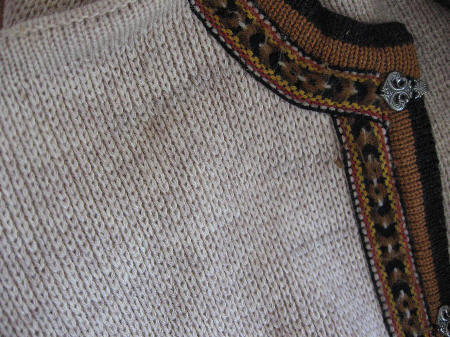
Twenty holes in the body and sleeves, one inside the collar, and two frayed cuffs repaired!
I had not actually seen this article on repairing knits when I started, but it’s worth keeping on hand —


 A Bluestocking Knits
Leave a comment