
Francis Towne, "Ariccia" (1781), British Museum, London. I’m afraid that this scan looks more than a little grey, but it was the only one I could find of this lovely little watercolor — the trees are actually a beautiful Italian dusky-green, against a pale creamy-blue sky. Ariccia (sometimes spelled "Arricia" — Towne wrote "Larice" at the bottom) is an ancient town near Rome, redesigned in the mid-1600s by Bernini, whose dome of the church of Santa Maria dell’Annunciazione appears in the background here.

Edgar Degas, "A Carriage at the Races" (1869), Museum of Fine Arts, Boston. So elegant, so Degas! I love the smoothness of the grass, the sheen of the horses, the combination of imbalance — the mass of the horses at the right against the near-emptiness at the left — and balance — the driver, the dog, the mother, the second lady, all focussed on the baby under the pale yellow parasol at the center.

Paul Cézanne, "Mont Sainte-Victoire Seen from Bellevue" (ca. 1882-85), Metropolitan Museum of Art, New York.
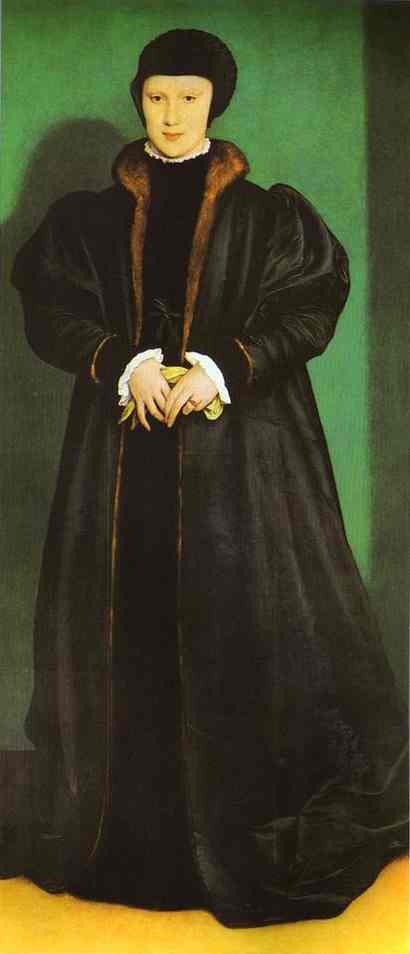
Hans Holbein the Younger, "Christina of Denmark, Duchess of Milan" (1538), National Portrait Gallery, London. A fabulous effort by one of my favorite portraitists. The yellow floor and the green wall (with its mysterious shadow on one side), the wonderful flow and texture of her gown, her level, strong-willed yet rather seductive gaze — brilliant. I love the story that when the suggestion was made that the young widow marry Henry VIII — who was then casting about for his fourth wife — she replied that if she had two heads, she might, but as it was she had only one. Holbein has certainly given the impression of a girl who can hold her own on the Renaissance political stage!

"Bronze Statuette of Bastet" (26th Dynasty, 664 BC-525 BC) Senusret Collection, California Institute of World Archaeology, Santa Barbara. One of my most beloved possessions is a reproduction of a similar Egyptian cat from the British Museum. This is an equally lovely one, although slightly different, mostly about the ears, which are pricked forward in the British Museum’s cat. The serenity of this little cat appeals to me greatly, and the way that the artist has captured the essence of cat-ness.


 A Bluestocking Knits

Leave a comment