I’ve at last gotten around to seeing the new "Pride and Prejudice" — due to the surprisingly early DVD release date! I got much of the right front of the Swing Jacket knitted up while watching it.

I was astonished to see that except for her very first scene, Elizabeth did not wear a petticoat. I cannot claim to be an expert in this matter, but I believe that this is akin to a woman going braless in the 1950s — just not done. I was also rather surprised that she almost never wore a hat — now, Elizabeth is something of a free spirit, but although it might be supposed that she would "forget" her hat when walking to Meryton, I cannot believe that she would appear at Lady Catherine de Bourgh’s bareheaded. I am also astonished that Mr. Bingley would simply open the door of Jane’s bedroom without first knocking — and that Lady Catherine would appear at the Bennets’ in the middle of the night — while this lady, too, is strong-willed enough to expect the world to cater to her, a midnight call is rather mind-boggling. (I think that we are supposed to believe that Darcy’s midnight call on Elizabeth, at the Collinses’, is a kind of dream, and that his letter’s appearance in her hand comes as something of a surprise to her, but this makes the two calls together rather puzzling.)
(Regarding hats, it seems to me that Elizabeth would be much like Laura Ingalls, who would usually wear her bonnet but push it back off of her head. It seems like she was always grudgingly pulling it back up.)
It’s also disconcerting to hear, in the opening scene, a stunningly beautiful piano piece and wonder if we are expected to believe that Mary is playing it, the same Mary whose clumsy music "delights us long enough" later at the Netherfield ball.
And of course, the fact that the film is only two hours makes it much more difficult to explore the nuances of character and family relationships so delightful in the longer versions. I understand, in this light, that many of my favorite lines have ended up on the cutting room floor, or not even in the shooting script, alas — although I was surprised that Mr. Bennet’s little tease of his wife regarding their new neighbor Mr. Bingley, "It is very unlucky, but as I have actually paid the visit, we cannot escape the acquaintance now" (which I was looking forward to hearing from Donald Sutherland), was altered to no obvious improvement. Mr. Wickham was a bit of a loss, too — and I did think it better that his spilling-out of the story of Darcy’s perfidy (as Wickham presented it, anyway) was much better coming impulsively (on purpose) from himself, as in the book, than from Elizabeth asking him — which made him seem less of a cad.
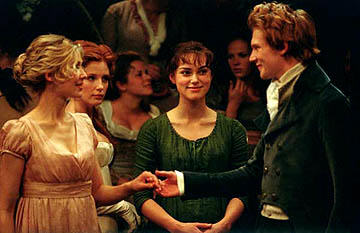
But cavils aside, this is a lovely film to look at. The locations are utterly gorgeous. It’s funny, how fashions change in the way we film period pieces, isn’t it. Twenty-five years ago, everything was clean and the colors were bright and everyone wore gloves when they touched each other — ten years ago, we discovered sex, and this year, dirt. I can believe that the Bennets’ home might be shabby, but not, I think, Shabby Chic. The amount of paint flaking off of the walls was incredible! and would, I think, have opened them up to a censure that Mrs. Bennet at least would have found mortifying.
I did like that there were so many night scenes. I suppose that in the first series the demands of video required that either filming was done mostly during the day or that night scenes be brilliantly lit — it does make more sense that night scenes, either at home or at a ball, be by candlelight, after all, and here it seems much more realistic.
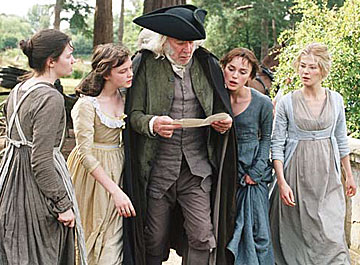
It was unusual and yet not unpleasant that the family dynamic has changed here from other versions — this Mr. Bennet especially is much less disparaging of his younger daughters and his wife, whose silliness is not as readily apparent. Mrs. Bennet especially gets more justification for her behavior, and actually gets to point out to Lizzie that five daughters need to be married off.
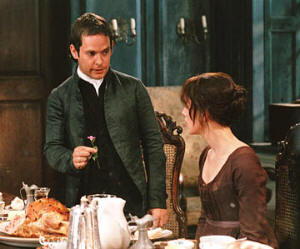
Tom Hollander was unexpectedly marvelous as the odious Mr. Collins, who is usually a figure of fun, but here was kind of awful and yet pathetic.
This indeed an enjoyable adaptation of the novel — not, obviously, as faithful as the 1995 version nor the 1980 one, which is still my all-around favorite. But this new one does have its own strengths and beauties.
(And here is a little unexpected Project Spectrum red: "Queen of Night" tulips from the Formal Gardens at Groombridge,
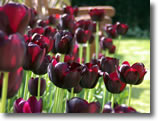
which was used for Longbourn in this film.)


 A Bluestocking Knits


Leave a comment