I finished the second sleeve of the Aran cardigan last night, so there was no more putting it off — time to cut.
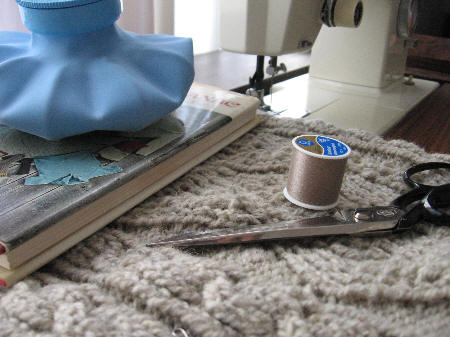
It’s really very simple — run a line of basting down the center of the place to be cut, then run two lines of very short stitches along each side of the basting, then cut along the basting itself. If the line to be cut stops in the middle of the knitted piece, as for an armhole, run a horizontal line of reinforcement stitches just below. (This ends up looking similar to a zipper’s stitching.)
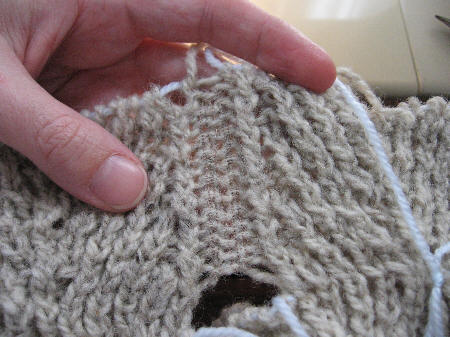
Here are the basting and stitching lines of the neck front, ready to cut. It was a lot easier to sew and cut on the reverse side, since in my particular Aran that was where the knit stitches (the wrong side of the purl stitches) made lovely guide lines for me.
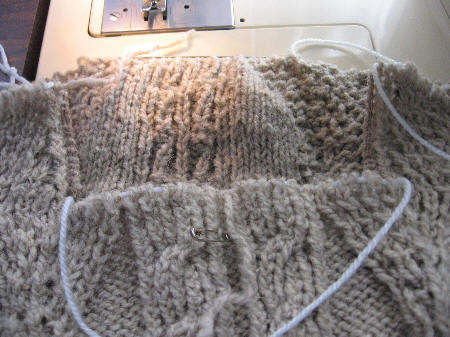
The "kangaroo pouch" does fall into place quite nicely, just as Elizabeth says. I didn’t think of it until it was too late, but the technique would also make perfect armhole gussets, thereby reducing some of the bulk at the underarm — six or eight stitches would probably do, but you’d have to take it into account when laying out the Aran patterns beforehand (e.g. if you want the cables to run up the sides of the armholes). Elizabeth didn’t suggest it, but I added a few extra purl stitches for a kind of seam allowance — sacrificial purls, really. I estimated about where I thought the armholes would start, and an inch or so below that I added another stitch for this purpose, although as it turned out I underestimated and had to cut considerably further than I’d expected.
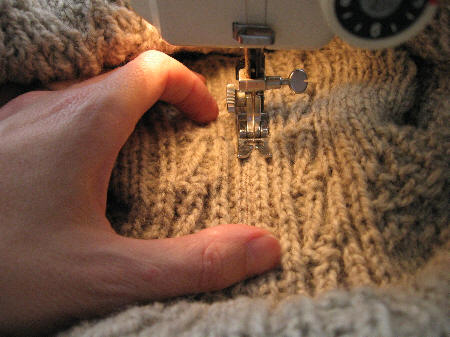
Sewing down the body was tricky, as the flexibility of the knitting and the fact that it was still a tube made it hard to hang on to, kind of like giving a ten-month-old toddler a bath. Each line gets easier, though, as the one before holds things in place.

If the thought of this makes you queasy, look away now. It’s kind of horrible and fascinating at the same time.
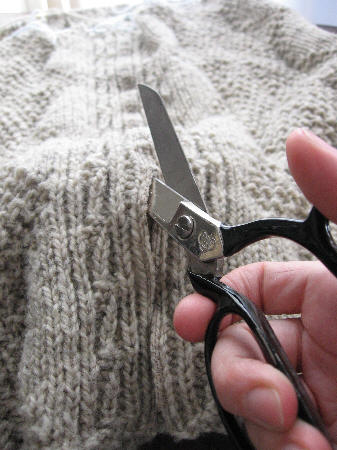
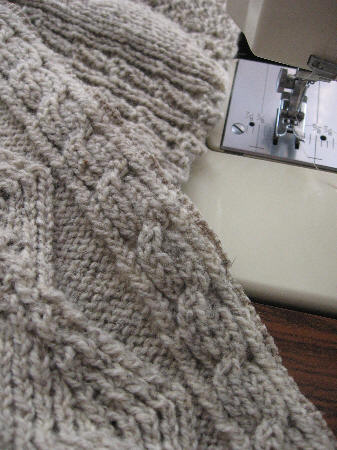
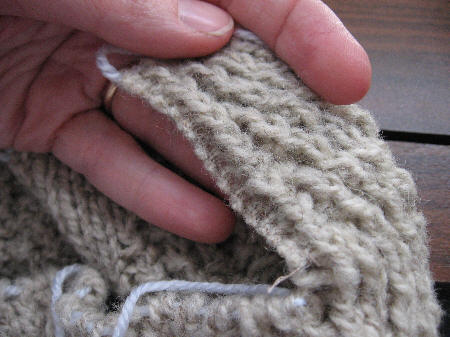
It is nice and tidy, and I can see where it would make a great deal of difference in Norwegian sweaters and such, where working multicolored patterns flat can be a real chore (especially with more than two colors), but I must say that I’m not entirely convinced that this is the solution for me, or for every project. (Haven’t tried knitted steeks yet, of course.) I’m not wild about the stiffness of the machine-stitching compared to the knitting — it is similar to the feel of a ribbon sewn onto the back of the front band of a cardigan. But I’m glad I’ve tried it, after all — now, on to the button band!


 A Bluestocking Knits
Leave a comment