The Knitter’s Almanac project for January is an Aran sweater, an appealing idea for these chilly days. Elizabeth gives us a brief background of Arans, then leads us gently into the designing and knitting of those textured marvels from the Aran Islands.
Let me say from the beginning that while I’ve of course known of Elizabeth Zimmermann for many years, I’ve not actually taken the opportunity before this to study her, as it were, to knit her designs in depth. But I loved her voice from the very first — it’s probably also why I like Nigella Lawson so much, that she writes in such a way as to bring her warm, engaging personality into one’s living room (or kitchen). They both make it sound so fun to knit, or cook, that sometimes I can’t even finish reading before I’m reaching for a saucepan or a pair of needles. I found the Knitter’s Almanac one day many years ago on the donation shelf at the library where I worked, and was intrigued, so I put my 25¢ in the box and brought it home — a very good use for a quarter, I must say! One of the most wonderful things about Elizabeth is that she is so calming, so reassuring, the perfect voice for a teacher. She talks at one point in this first chapter about how she always knits cardigans in the round, then cuts them, and this idea has always filled me with panic and revulsion. But in three words, "Then — horrors — cut," she not only identifies and sympathizes with my anxiety, but reassures me that it will all come out right.
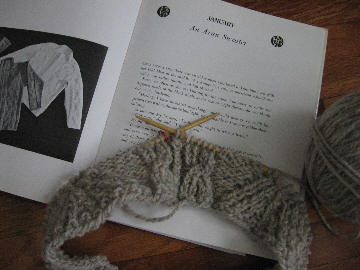
I’m glad I started a few days early, actually, as I’m having a bit of trouble getting a gauge I like with the Sheepswool and the size needles I have. (Michael’s, I think the only source for me of knitting needles within a ten-mile radius, has nothing smaller than US7 circulars, and no dpns, not a one!) But time has not been wasted, because in the swatching process, I am getting to practice with the main pattern, a wide one that Elizabeth calls "Fishtrap," because it reminds her of one. A new technique I’ve learned already is the travelling stitch, that interesting phenomenon of a single cable effected by simply working the second stitch before the first one. The travelling stitch leans to the right or to the left by virtue of starting the twist either from the back or the front, respectively. This would in a larger cable be performed with a cable needle, but here, as Elizabeth says, "After the first few times of taking a single stitch on a spare needle, holding it in front or at the back while you knit the next stitch, and it trying to slide off all the time, the craythur, you will smartly come to the decision not to fool around with spare needles, but simply to knit the second stitch first and the first one second, and slide them both off the lefthand needle together." While technically not a purl stitch, the back stitch functions as one here because it recedes, rib-like, bringing the travelling stitch into focus. (I was a bit confused by her directions for the Right Twist, which essentially are K2 tog but do not slip from needle, K first st again, and slip both from the needle. It never did look right to me, so I had to Google the procedure, and found different (and contradictory) versions in which the second step knits either the first or the second st again. This seems to be a mistake, as I can’t get the twist to work knitting the first stitch again, only with the second.)
(And I did find two errors in the chart, two missing purl stitches. The "Fishtrap" pattern has a simple double-symmetry that makes the chart omissions jump out at the moment you reach them. Perhaps this was corrected in the later editions?)

I confess that I took a shortcut and first "swatched" on the sleeve. A bit of a gamble, which may or may not have paid off, I haven’t decided yet. The sleeve/swatch on US5 (!) is a bit stiff, while the larger swatch ("make a hat," Elizabeth suggests) on US6 seems a bit loose.
Some favorite quotes from this chapter: "Take some of your wool and the size needle your intelligence tells you might be right, and make a swatch." "Experiment, for goodness’ sake." Sound advice in the matter of gauge, and well-said. (Maybe I should make swatch and wash it….) And, you know, if Elizabeth was responsible for nothing else but the suggestion to pattern-writers and editors to knit the swatch for a pattern stitch over stockinette, I would still sing her praises. How many times is it impractical or impossible to work a swatch in pattern?! "You can take note of what I do, and do likewise; or improve on me." "Once you have tried complicated patterns, or even simple ones, from … charts, you will look only with pity on written-out directions." (It’s strange to think that back in the mists of 1974, charts were still a new thing. I learned from written-out instructions, in fact, and remember doing a Shetland baby blanket from pages of K2 tog, yo, sl 1, K1, psso, &c &c &c.)
"After all this I hope you will feel inspired to design, calculate, and execute your very own personal Aran, like unto nobody else’s."


 A Bluestocking Knits
Leave a comment