Have been humming along with Amy Detjen’s Beginner’s Triangle shawl, featuring the Centered Eyelet. This is an interesting technique, and prompted me to take a closer look at it. Frankly, I am amazed at the kind of mind that would come up with something that includes "k second st but do not remove from LH needle". I say this with the utmost admiration, as it would certainly never occur to me to do anything of the sort, being a fairly unadventurous knitter technique-wise!
Here is the problem —
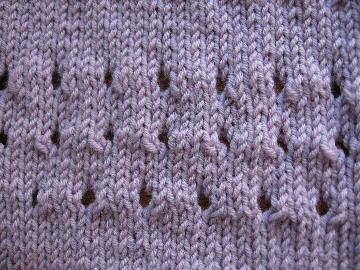
that eyelets, worked either as k2tog, yo (bottom row) or as yo, ssk (middle row), are asymmetrical, leaning either to one side or the other. This could be partly avoided with working the eyelets as ssk, yo (top row), but even though this disguises the slant somewhat, it is still obvious that there is a decrease on one side and none on the other.
Of course, this slant or running stitch can be used decoratively, as in this little digression, in which the slant appears to travel upwards in a nice little s-curve —

But Detjen wanted to have rows of eyelets that crossed one another in a diamond-shaped pattern, and here the lack of symmetry bothered her.

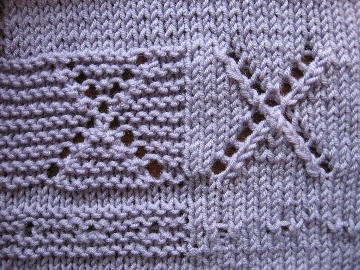
Notice the rather lackadaisical point where the X crosses (I used yo, ssk). That single eyelet is certainly in the middle, but it is not centered, as the decrease makes the running sts, especially the ones traveling from lower right on each X to upper left, look bulky. It would probably have been better to work a different decrease, as at least that side of the X would have a perfect line of running sts from bottom to top, but it would still not have been symmetrical.
Here is Detjen’s solution, the centered eyelet:
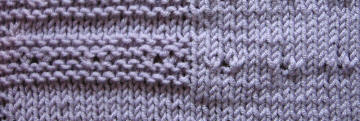
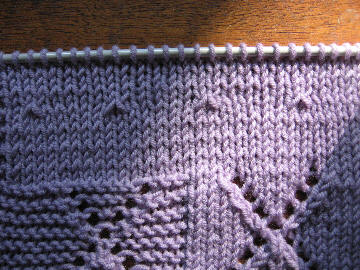
(Worked over 3 sts; 3 sts remain.) Sl first st knitwise, k second st but do not remove from LH needle, psso, yo, k2tog (3rd and 2nd sts). On the next row (WS), k into st below each yo of the centered eyelet. The garter st version on the left is as in the Beginner’s Triangle; the st st version, on the right, is for clarity. (Note that in the stockinette version, I had to tweak the sts afterwards with the point of a needle, as they didn’t sit quite right. The one on the left is untweaked, to show how it looks at first.)
Here are the steps for the centered eyelet (garter st version), partially broken down:
"Sl first st knitwise, k second st but do not remove from LH needle…"

"psso…"

"yo…"
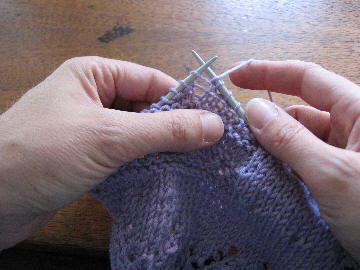
"k2tog (3rd and 2nd sts)…."
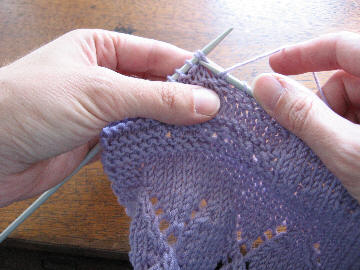

On the WS row, at the yo of the centered eyelet, "K into st 1 row below…."
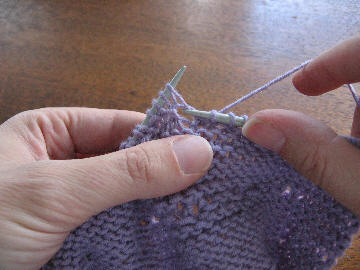
Detjen says that she based the centered eyelet on Robert Powell’s 3-into-2 decrease, which is identical to the centered eyelet but without the yo in the middle (and so without the "k into st below" in the second row as well).
Here is the beta version, if you will, of the centered eyelet:

Notice the horizontal bar across the eyelet. (Interestingly, the bar is in the middle of the eyelet in the garter st version, and across the top of it in st st.) On the next (WS) row, knitting into the st below the yo (and of course including the yo, which gave me pause for a moment) solves this problem, by simply pulling the bar up out of the way. On the st st version, you would purl into the stitch below.
Two Xs worked with the centered eyelet, one in garter and one in st st, nice and tidy:
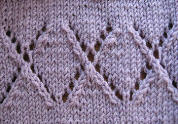
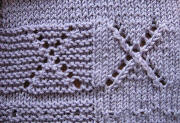
It might be interesting to try this in an all-over eyelet pattern….
And as a bonus, we can now do the 3-into-2 decrease!


 A Bluestocking Knits


Leave a comment